The Importance of Plot: How a Strong Beginning, Middle, and End Hooks Readers
Plotter? Pantser? Somewhere in between? No matter your approach, plotting your novel can be a huge challenge. But without a clear plot, even the most beautiful sentences are a loose series of events rather than an intentionally constructed reading experience. Plot gives a manuscript shape, momentum, and pacing.
In this week's blog post, I am going to dive into a major building block of your plot: beginnings, middles and ends. These elements shape the way a reader experiences, each with its own purpose. Let's get into it!
The Difference Between Plot and Story
Plot refers to the external sequence of events within your manuscript. Some story elements that fall under plot includes plot points, setups and payoffs, scene structure, and more. It's common for writers to prioritize planning the external events of their story first, as it's often considered the most exciting part. However, a good plot is nothing without a compelling internal story.
Story is the internal mechanism of your manuscript. These are things like character motivation, themes, and stakes. It is your protagonist's response to the external events. As Lisa Cron puts it in Story Genius: How to Use Brain Scene to Go Beyond Outling and Write a Riveting Novel, “In a nutshell: A story is about how the things that happen affect someone in pursuit of a difficult goal, and how that person changes internally as a result.”
But today, we aren't talking about story. Instead, I want to walk you through exactly what your plot should do for your internal story journey.
Plot Definitions
At its core, plot is the deliberate arrangement of events connected by cause-and-effect. It is not just what happens, but how each story moment pushes the narrative forward. This logical progression of plot creates the backbone of your story. Here are some definitions that I commonly use when considering the plot:
Plot Points - A plot point is the external event in each individual moment of your story, or the external experience of the characters on the page. If your reader were watching the scene from above, what would they witness?
Cause and Effect Trajectory - A logical progression of the external events of the story where each plot point causes the next.
Scene Structure - At the scene level, the plot includes the external forces of antagonism working against your protagonist's internal goal in every scene. I encourage writing stories in scenes—not chapters—to highlight the importance of both internal and external elements in each unit of story. Scenes make up the arc of change within each Act of your manuscript.
Act Structure - Acts create arcs of change within your manuscript by moving your protagonist from one context to another. You can measure how each Act's external events, or plot, change your protagonist's circumstances within their world.
External Plot Problem - The global plot conflict faced by your protagonist. This is the plot conflict that spans the entire manuscript from the first page to the last.
Three-Act Structure vs. Four-Act Structure
The three-act structure divides your story cleanly into the Beginning, Middle, and End. However, the Middle is just as long as the Beginning and End combined. Every part plays a key role, but let's discuss that in a bit.
I won't try to persuade you on my favorite, but all my clients will tell you I am a strict devotee of the four-act structure. Why? Four-Act Structure allows you to ensure the first and second half of your story are equally written when you consider the importance of pacing. Rather than a broad Middle Act, four-act structure breaks the middle into two interchangeable trajectories: a positive Middle Build and a negative Middle Breakdown.
If Act Two is a Middle Build, then Act Three is a Middle Breakdown—or vice versa.
Both structures organize plot into a meaningful sequence of events, with the four-act model simply offering a more detailed breakdown of the middle. No matter the model, plot structure exists to control pacing and escalation.

Plot Structure Explained
Plot structure maps how a story moves from exposition through rising action, climax, falling action, and resolution. It ensures the plot unfolds with intention rather than accident.
Key Plot Elements in Beginnings
Beginnings are all about the initial promises made to your reader. There are many of these, but specifically for plot, it is important to establish the external plot problem, introduce the antagonist, and establish the stakes should the protagonist cannot solve the external plot problem.
The beginning also holds an important plot point--the inciting incident, or the external catalyst that sets up the big picture of your story arc. The elements of plot established in the first Act of your story convince your reader that your book is worth reading, so it's important that they induce curiosity. However, writers often overlook the cohesiveness of the story plot, and the beginning events must clearly tie into the story's climax.
Throughout the manuscript, the beginning of the story and end of the story connect in many ways, but it's best to introduce and resolve the external plot problem within the first and final acts, respectively.
Plot in the Middle
I find the Middle of a manuscript the hardest to write. To effectively plot the middle of your novel, writers can use rising action, complications, and escalating stakes. Each plot point builds on the last, creating a clear cause-and-effect chain that keeps readers invested.
Rising Action and Falling Action
Rising action increases tension through challenges and decisions, while falling action allows the consequences of the climax to settle. Together, they control how the plot breathes before and after its turning point.
Sometimes we call these setups and payoffs. In the Middle of the Story, your protagonist attempts to solve their external plot problem. They may make progress in some regards, but cannot fully defeat their antagonist until the end. Plot development in the middle relies upon a series of wins and losses as your protagonist actively pursues their story goal on the page. The reader's narrative drive in this portion of the book is fueled by the question, "Will the protagonist succeed against their antagonist, or fail?"
The plot is a sequence of events following a pattern of setup and payoff. A good plot follows this pattern, providing clear resolution to each point of the story.
Ends: Resolution of the External Plot Problem
From the beginning to the end of your manuscript, your protagonist attempts to solve their external plot problem through a series of choices. In this part of the plot, the hero finds the solution to overcome their enemy. The finale resolves all loose ends in a satisfying, yet inevitable way.
A compelling plot is resolved with an ending that is satisfying, yet inevitable. Most times, your protagonist will sacrifice something to prove that they have learned the internal theme before defeating their villain. At the end of the story, your reader understands how the plot deeply changed your protagonist internally.
Types of Plot and Common Plot Devices
The type of plot is sometimes called the external content genre. When editing, I use the Story Grid Method to determine if plot elements align with a certain archetypal structure. These include action stories, love stories, thrillers and more.
External content genres are the type of story that you are telling. Since your reader is consuming stories all the time, these provide familiar elements that speak directly to your reader's subconscious.
Main Plot, Subplots, and Story Plot Balance
The overarching events in a story as they relate to the external plot problem create the main plot. Subplots are all side quests, subgenres, and story moments that create nuance and depth, but do not help solve the external plot problem.
One of the most common subplots is romance. When considering your subplots, I always recommend tying them to your internal story journey, or your protagonist's internal arc of change.
When balanced well, each subplot reinforces the central plot and its internal story rather than distracting from it. More than one scene in a row that focuses solely on a subplot can detract from your narrative.
How to Create a Plot That Works
Every story requires a unique plot that complements the internal story journey and theme. Plots don't exist in a vacuum, so working with these other storytelling elements will enhance the cohesion of your manuscript.
Plot contrivances, or story moments that occur for no other reason that to push the plot in a certain direction, make your reader feel as though your characters are pieces on a chessboard being pushed by a heavy-handed author. Instead, A strong plot grows from intentional choices by your protagonist rather than random events.
This means designing a plot specifically to challenge your protagonist's internal false belief. In certain plot environments, one protagonist might struggle while a different one could thrive. The goal is to specifically challenge your main character with the external events of the story. The plot and the protagonist must be a good match for each other.
Using Plot Structure
If using a specific plot structure makes you want to run for the hills, let me persuade you otherwise. Often, writers view their plots as a series of events. But its role is much bigger than that. See, readers are consuming stories all the time as movies, TV shows and even tales from their friends. Our brains are hard-wired to perceive the structure of a story, even if we don't know it.
Without a plot, your reader will feel like something is missing from the story. My goal is to help writers embrace effective plot structure as a tool to hook their readers rather than a rigid structure that kills their imagination. When you use plot, you are capitalizing on all the subconscious information your reader knows about storytelling
Plot structure provides a framework for shaping ideas without limiting creativity. Whether drafting a novel or a short story, structure helps the plot remain focused and cohesive.

Plot Outline Example
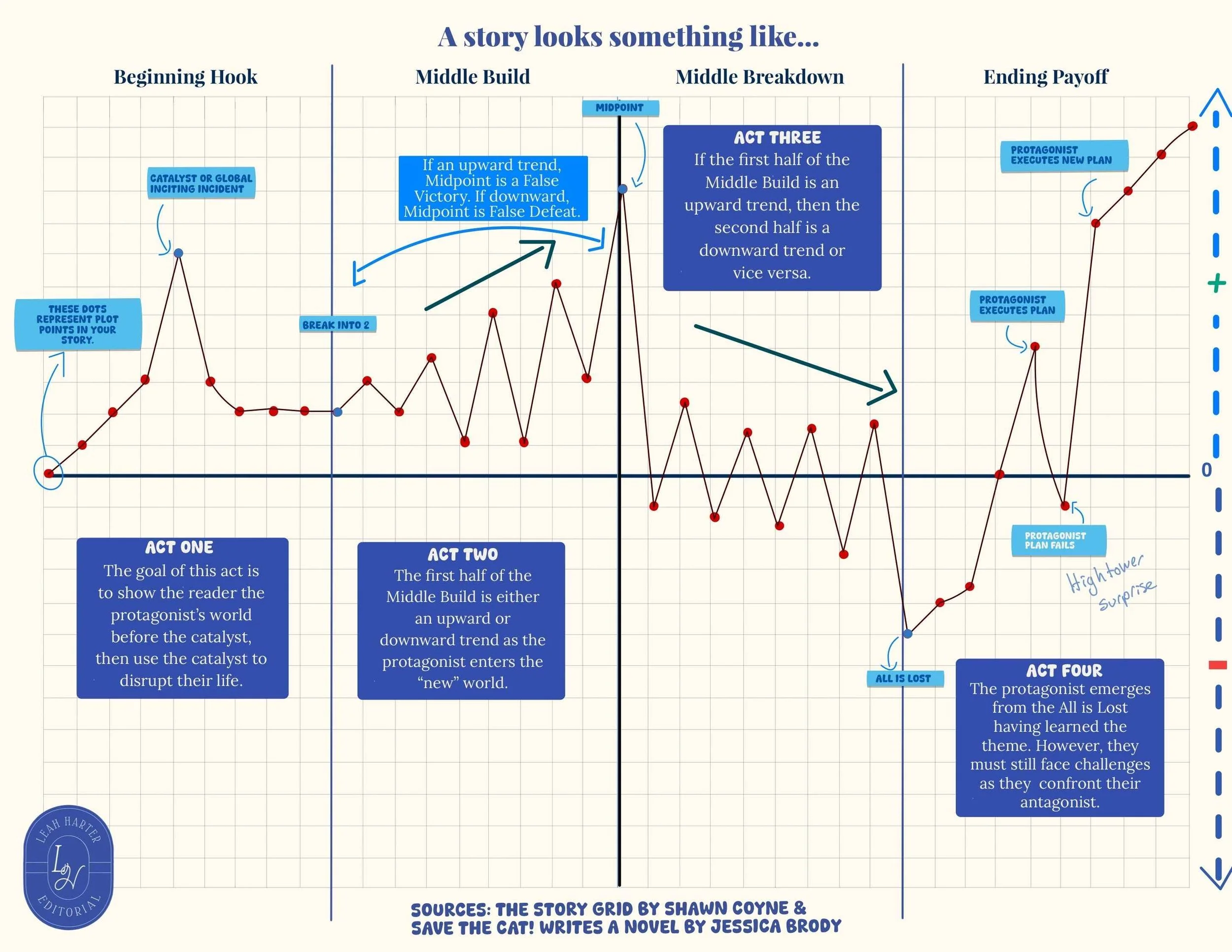
Now, that we've covered basic plot tips, let's look at a visual to help you write a plot that resonates with your story. This plot diagram turns abstract plot concepts into a clear and usable roadmap to writing a plot that pushes your story forward. Here is an example of what your story might look like with a clear beginning, middle and end.
That’s all for now! For more writing tips and tricks, feel free to reach out to me or learn more on my Instagram below: