Every Type of Character Arc Explained (And How Plot Makes Them Work)
What if your character doesn’t become a better person by the end?
Character development is often treated as a requirement of good storytelling, especially within Western narrative tradition.
Most stories are built on the expectation that the protagonist will grow, learn, or transform in a positive way as the plot unfolds. In practice, stories with a negative character arc can be just as powerful. When a story applies meaningful constraint, a character either changes, or doesn't when they face their final antagonist.
Both outcomes are valid, and both can work when the story understands the deeper truth it reveals.
A positive character arc is not mandatory to write a great story. However, you do need to understand the alternatives and how a character arc works in conjunction with your plot in order to write a cohesive narrative. Let's dive into it.
What a Character Arc Actually Measures
At a fundamental level, a character arc tracks the protagonist's understanding of a deep truth about themselves or their world. At the beginning of the story, the character starts with a particular worldview. That worldview shapes how the protagonist interprets danger, opportunity, and consequences. Often, the character believes something that is either incomplete or actively harmful—an internal false belief that once helped them survive but now limits them.
As the plot arc unfolds, the external events introduce challenges designed to expose the cost of that belief. The internal character arc, or internal story journey, intersects with the external plot at five key scenes throughout the narrative.
The Inciting Incident, or Catalyst, destabilizes the character’s life by disrupting their status quo in a way that forces action. At the Break Into Two, they make the conscious choice to step into their story world and take on their antagonist. By the Midpoint, the reader is aware that the internal false belief is no longer sustainable without sacrifice in the external parts of the narrative. At the All is Lost, the protagonist suffers a huge blow by the antagonist, which forces them to question their choices thus far. Finally, the story escalates until the Climax, where the character must act in a way that reveals what they truly value.
Plot and the Internal Journey
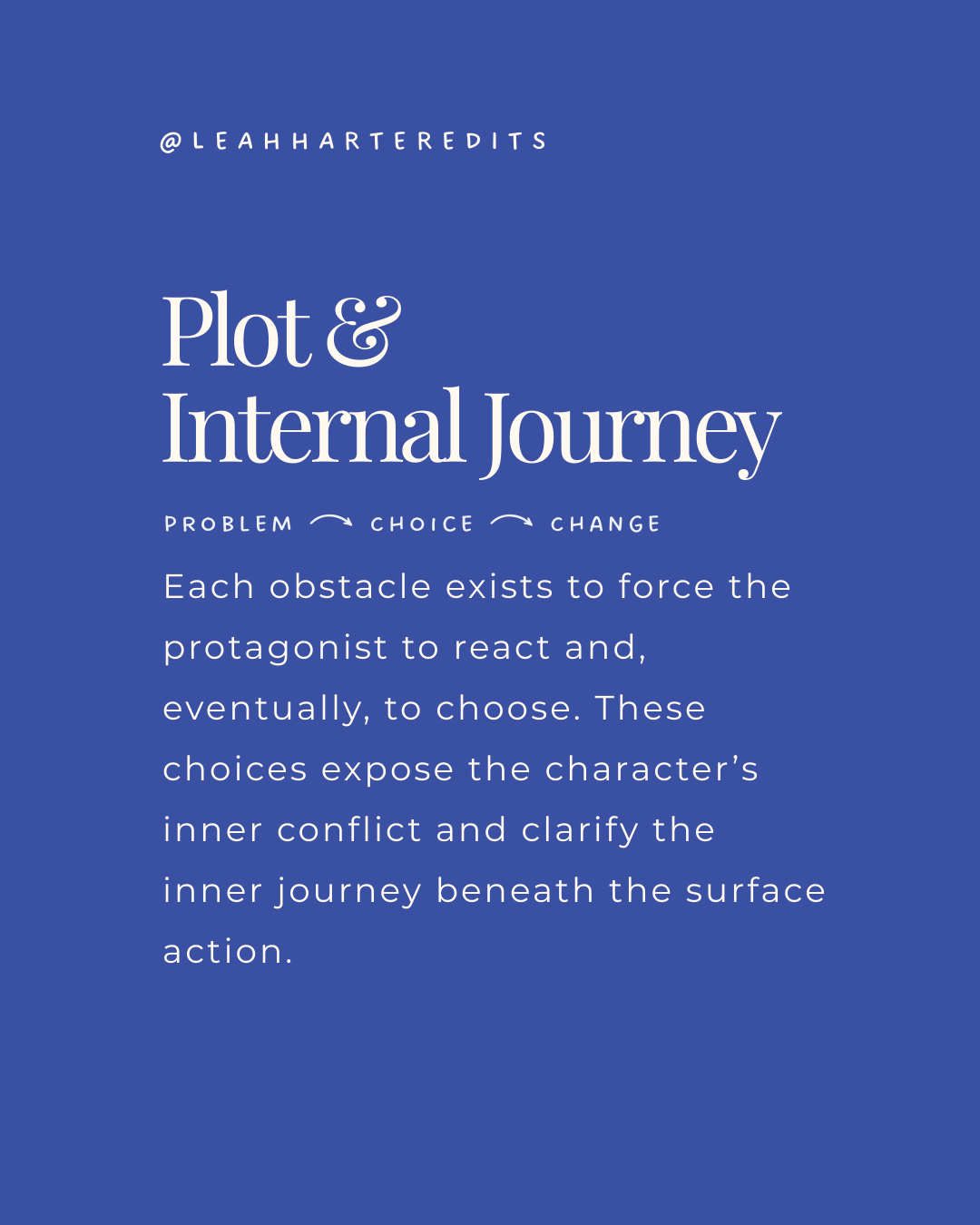
Over the course of the story, the character's arc of change is directly influenced by the external plot events of the story. Each obstacle exists to force the protagonist to react and, eventually, to choose. These choices expose the character’s inner conflict and clarify the inner journey beneath the surface action. As the story progresses, the protagonist might start to make different choices demonstrating how the events of the story are changing them.
The external struggle often takes the form of an antagonist, but the internal conflict is the result of your protagonist's internal false belief. The story asks what kind of person the protagonist will be when their values are tested. This is where internal conflict, external plot, and theme intersect.
A story succeeds when the external resolution reflects the internal decision the character makes. In this final decision, the reader understands the nature of the protagonist's arc of change.
Types of Character Arcs in Practice
Across literature, most stories employ one of three foundational types of character arcs. Knowing the function of each will help you pick the best one for your story.
The Positive Change Arc
In a positive change arc, the protagonist begins with a limiting belief that creates a deep internal flaw. This belief is specific to your story and your characters. It will be different for every story.
As the plot escalates, that belief holds them back from defeating their antagonist and achieving their external goal. The character must confront it, relinquish it, and embrace a more true understanding of themselves or the world.
This arc aligns closely with the traditional hero’s journey. The protagonist does not simply succeed; they do so because they are willing to change. The positive change arc allows the character to overcome the external problem by resolving the internal one. The result is a story that proves the theme to be true.
A positive character arc is not about becoming morally flawless. It is about becoming aligned with the truth and relinquishing the protagonist's internal false belief.
The Negative Change Arc
A negative arc explores what happens when a character refuses to relinquish a destructive belief. Structurally, it mirrors a positive arc, but the outcome is inverted. Rather than defeat the antagonist, your protagonist fails.
This is common in duologies where the first book ends in a negative arc and the second ends in a positive arc.
The negative character arc is not a failure of story structure. It is a deliberate examination of how flawed protagonists cannot let go of deeply held beliefs. If your character doesn't change, that tells us something truthful about them and their world.. Here, the character may achieve their goal—but the cost reveals the story’s theme.
Flat Character Arcs and Moral Resistance
In flat character arcs, the protagonist does not undergo fundamental character change. A flat character begins the story already holding the thematic truth. The plot exists to test whether they can remain steadfast under pressure and change the world around them.
Rather than transforming, the protagonist becomes a catalyst. The world around them must adapt or break. Flat character arcs are common in detective fiction and mythic narratives, where the protagonist’s role is to expose corruption rather than resolve it internally.
Consider Sherlock Holmes. Sherlock does not need to become a better person to function as a protagonist. His value lies in consistency, not growth. The story’s tension comes from how others respond to his unwavering logic.
Do Characters Need to Become Better?
The assumption that characters must become better oversimplifies narrative purpose. Stories do not exist to improve characters. They exist to explore the human experience.
A protagonist might grow, fall, or remain unchanged. What matters for you as the writer is understanding what type of internal journey your main character is experiencing and what impact it will have on the broader story arc. Nuance is important to understand here. The character might fail morally while succeeding practically, but fail to defeat their antagonist. They might refuse growth and force the world to reckon with them. They might learn exactly what the story demands.
What they cannot do is escape consequences. Even if your character's arc of change is flat, their choices must clearly affect the outcome of the story, force them to face meaningful stakes, and create tangible changes on the page.

Conclusion: Writing Character Arcs with Intent
To write a great story, identify the type of internal arc that will provide the most benefit to the theme and narrative through-line of your story. Are you writing a cautionary tale about a fallen hero? Or a prescriptive one about conquering an internal obstacle? Next, consider what the character values, what they fear, and what belief the plot is designed to challenge. Finally, determine what the character makes happen externally because of their internal decisions over the course of the story.
A great character is not defined by improvement, but by the reader's clarity of how their external actions matter internally. Whether the arc is positive or negative, whether the character serves the greater good or self-interest, the ending resonates when the protagonist's internal arc and the climactic action aligns with the story’s theme.
That alignment—not growth for its own sake—is what gives character arcs their power.
That’s all for now! For more writing tips and tricks, feel free to reach out to me or learn more on my Instagram below: