5 Reasons to Read Story Genius by Lisa Cron (+ a Free Scene Card Template)
Here’s a scenario I hear from writers constantly: you’ve got a draft. Maybe even a full one. The plot technically works, the characters aren’t terrible, and yet something is off. The story isn’t landing the way you hoped, and you can’t quite put your finger on why.
That’s exactly the problem Story Genius by Lisa Cron was written to solve.
I’m Leah, a developmental editor specializing in speculative fiction. I created this craft book review series for one reason: to help you stop guessing and start finding the resource that actually addresses your specific writing problem, not just whatever everyone on Instagram is talking about this month.
Because here’s the thing about craft books: there’s no one-size-fits-all solution. If you’re choosing between Story Genius, Save the Cat Writes a Novel, or Story by Robert McKee, the right answer depends entirely on where you are in your journey and what’s not working in your manuscript. This review will help you figure out if Story Genius belongs on your shelf next — and I’m including a free Story Genius scene card template you can put to work right away.
Full title: Story Genius: How to Use Brain Science to Go Beyond Outlining and Write a Riveting Novel (Before You Waste Three Years Writing 327 Pages That Go Nowhere)
The title alone should tell you something. If you’ve ever written yourself into a wall 200 pages in, Lisa Cron is speaking directly to you.
#1: Lisa Cron Uses Brain Science to Explain Why Stories Actually Work
Brain Science & Story: The Secret Weapon You Already Have
Have you ever stayed up until 2 a.m. reading a book you couldn’t put down and then struggled to explain to someone why it was so good? That’s brain science at work.
Lisa Cron opens Story Genius with a compelling argument: humans are hardwired for story. We’ve been using narrative to process information, predict outcomes, and understand other people since long before we had the written word. Story isn’t just entertainment. It’s literally how our brains make sense of the world.
For writers, this is good news: readers arrive pre-loaded with story expectations. They’re already primed to follow a protagonist, feel the pull of conflict, and want to know what happens next. The challenge (and Cron is clear about this) is that most writers unknowingly work against those expectations. They front-load world-building that doesn’t connect to the protagonist’s internal struggle. They write technically beautiful scenes that don’t change anything. They mistake adding more conflict for creating more meaning.
Once you understand why the brain responds to story the way it does, you stop writing and hoping it works. You start making intentional decisions and writing with confidence that your words will reach your audience.
#2: Story Genius Settles the “Character vs. Plot” Debate Once and For All
What Comes First — the Character or the Plot?
Ask this in any writing community and you’ll start a debate that lasts three days. Plotters say plot. Pantsers say character. Lisa Cron says: neither. And the answer has real, practical implications for your draft.
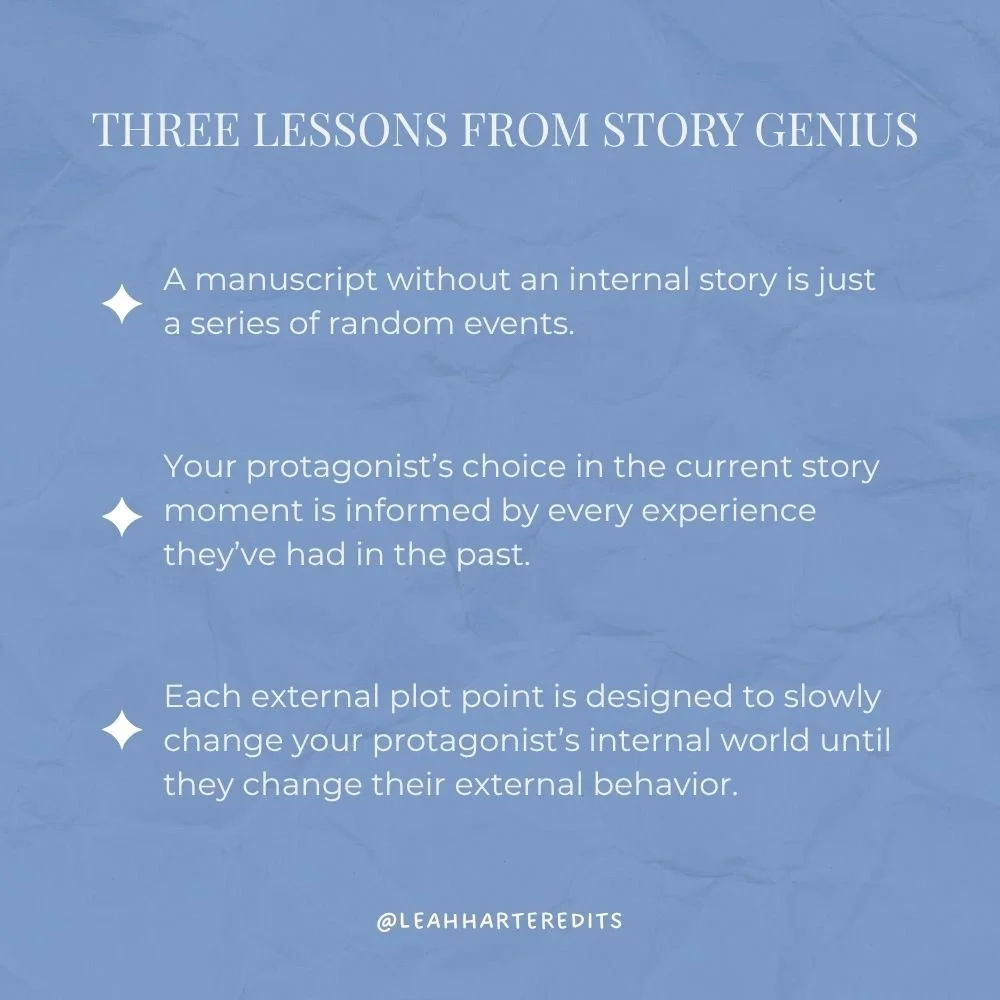
Here’s her core argument: your protagonist’s external plot problem should be specifically designed to challenge whatever internal false belief they need to overcome by the end of the novel. That sounds straightforward until you look closely at your own story.
Think about it this way: if your protagonist needs to learn to trust people again after years of isolation, but your plot puts her alone on a spaceship for three-quarters of the book, your plot isn’t doing its job. You’ve built a situation that lets her avoid the very thing she needs to confront.
The external and internal arcs aren’t two parallel storylines. They’re the same story. The plot is the pressure system that forces your character to change (or fail to change, which is also a valid choice). When they’re misaligned, readers feel it even when they can’t name it. The story feels like it’s going somewhere without actually getting anywhere.
This is one of the most common issues I see as a developmental editor, and Cron lays it out more clearly than almost any other craft resource I’ve encountered.
#3: Story Genius Teaches You to Build Backstory That Actually Does Something
Your Protagonist’s Past Is the Engine of Your Plot
Backstory has a bad reputation — and honestly, it’s earned. Infodumps, gratuitous flashbacks, prologues that go on forever. Most backstory in early drafts is dead weight.
But Story Genius makes a different case: backstory isn’t decorative. It’s structural.
Here’s the idea: humans don’t make decisions in a vacuum. We make them through the lens of everything that’s happened in our past, our fears, our assumptions, and our wounds. Your protagonist does the same. Every choice they make in your present-tense plot should be traceable back to specific moments in their past that formed their worldview.
Cron argues you don’t need a lot of backstory to accomplish this. You need the right backstory, or a handful of key moments that explain why your protagonist sees the world the way they do, and why that worldview is going to cause them problems right now, in your plot.
Her example: we don’t need to know your protagonist failed a 4th-grade spelling bee. We need to know about it only if that moment planted a paralyzing fear of public failure that now directly drives their decisions as your novel unfolds. Backstory earns its place by doing work in the present.
This section alone has shifted the direction of manuscripts I’ve edited. If your character feels thin even though you’ve written pages of history for them, this is probably why. Specifics create meaning. Context creates understanding.
#4: The Story Genius Scene Card Template Is One of the Most Useful Tools in the Book

A Scene Card Even Pantsers Can Love (Yes, Really)
If you stiffened at the word “template,” I see you. I’ve worked with enough pantsers to know that “outline” can feel like a creative straitjacket. But hear Cron out before you skip to the next section.
The Story Genius scene card isn’t a full outline. It’s a single-scene interrogation tool. Cron argues you need only your first few scenes mapped out before you begin writing. Plotters: yes, you can apply this across your entire outline. Pantsers: think of it as a revision tool, not a planning mandate.
Here’s what the scene card asks you to pin down for each scene:
Alpha Point - What is the basic description of the events of the scene?
Subplot - What are the additional storylines in this scene?
Cause - What is the tangible event that occurs in the story?
Effect - What impact does this scene have on the plot of your story?
Why it Matters - What does this plot point mean internally to the protagonist?
Realization - What does your character conclude based on the external plot problem?
What Changes - What changes (in the character, the situation or both) by the end of the scene?
Reader Takeaway - What does the reader now know that they didn’t know before?
And so - What is the specific and logical next step based on the character’s choice?
When a scene can answer all of those questions, it’s earning its place. When it can’t, that’s your signal to cut or rework.
The Tangled Lantern Scene: A Scene Card Example
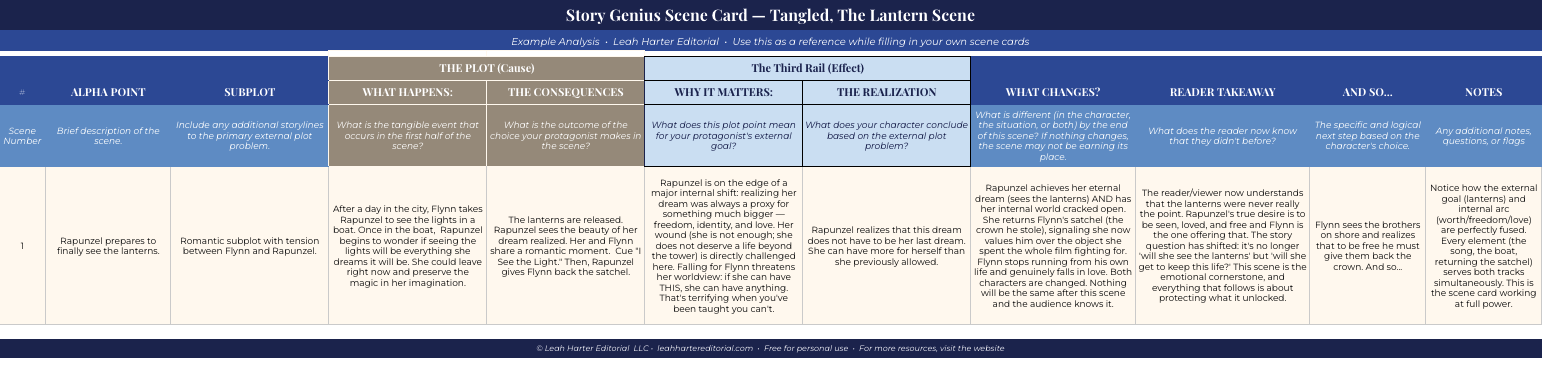
To show you how this works in practice, I ran the iconic lantern scene from Disney’s Tangled through a Story Genius scene card.
Tangled is a Great Example
This scene is a masterclass in how external action and internal arc can work in perfect sync. Rapunzel’s external goal (see the lanterns) is the vehicle for a much larger internal moment — she’s standing on the edge of her entire old worldview collapsing. Every element does double duty. Nothing is there just to look good.
Want to try it yourself?
I created a free, fillable scene card template in Excel so you can analyze your own scenes the same way.
Drop your email and I’ll send it straight to your inbox.
#5: Story Genius Walks You Through Every Concept With Detailed Examples
Is Story Genius the Right Craft Book for You?
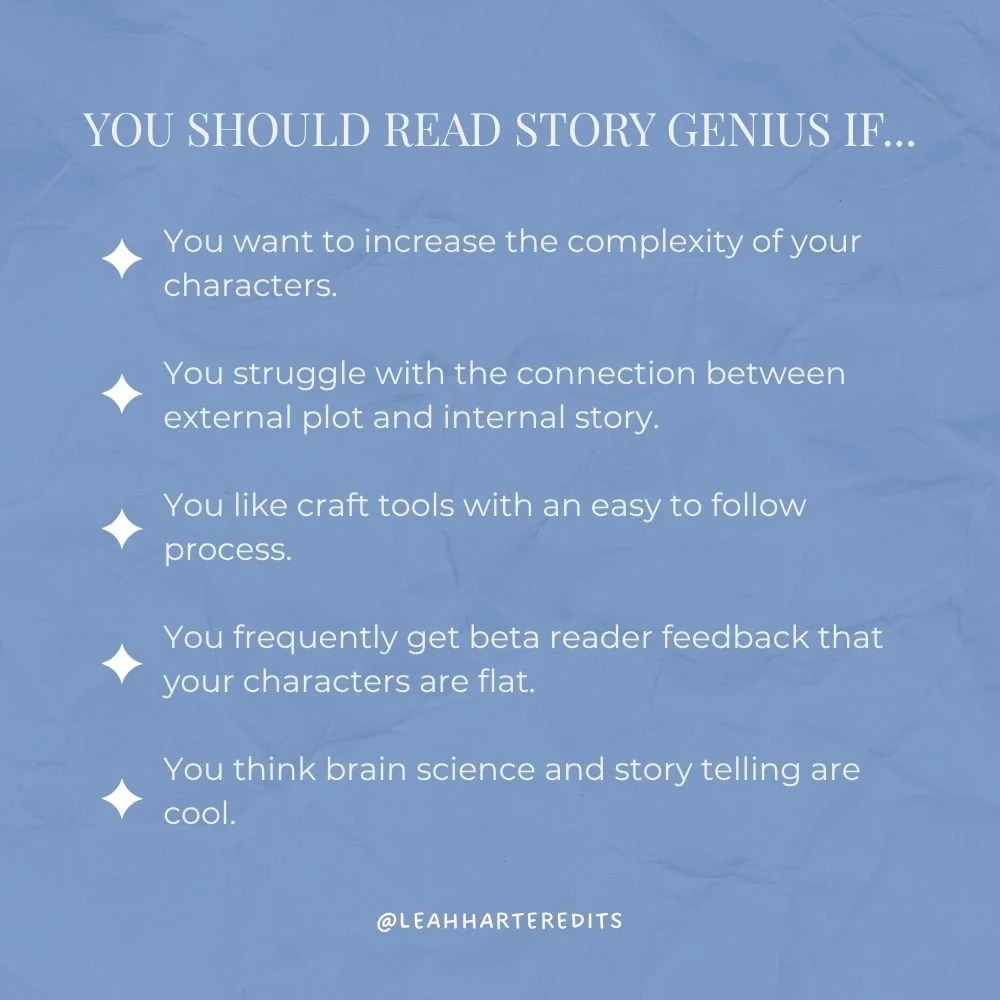
If any of these sound familiar, the answer is probably yes:
Your story feels like something is missing, but you can’t name it
Your protagonist’s arc and your plot feel like two separate stories running side by side
You’ve been told your character is reactive or passive
Your backstory keeps migrating to the first three chapters because you’re not sure where else to put it
You want a scene-level framework for revision — whether you’re a plotter or a pantser
One note: Story Genius isn’t the right first stop for every problem. If your main challenge is plot structure or world-building, you’ll get more mileage from Save the Cat Writes a Novel or The Story Grid first. But if the inside of your character’s head is where your story keeps going quiet? This is the book.
Take what works for you and run with it. And if you want that free scene card template to put Cron’s method to work right now — grab it below.
Until next time: keep writing, keep dreaming, and don’t stress about the shoulds. You’ve got this.
Ready to take your manuscript further than a craft book can take it alone? I work with speculative fiction writers on developmental edits, manuscript evaluations, and retainer coaching. Click here to learn more.